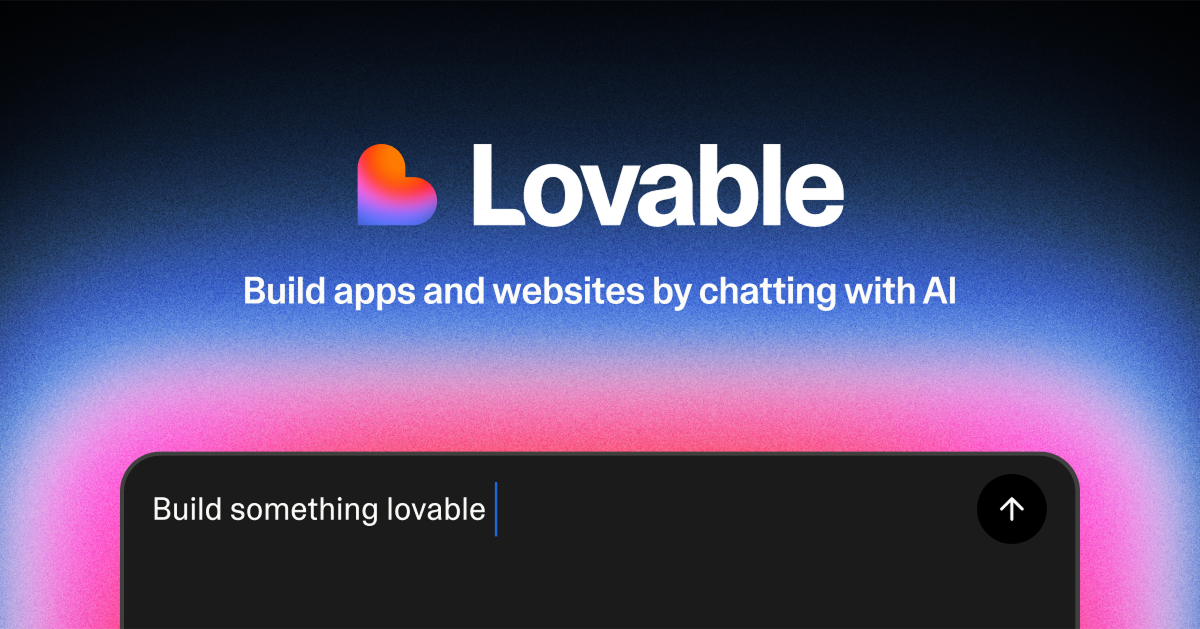
Lovable AI (often just called Lovable) is an AI-powered development platform that lets you build full-stack web apps and websites simply by describing what you want in natural language. Instead of starting from a blank editor, you chat with an AI that generates the code, scaffolds the backend, and gives you a visual editor to refine the result.
Where traditional low-code tools focus on drag-and-drop components, Lovable leans into conversation-first development. You explain the “vibe” and goals of your product, and the platform turns that into working software that you can run, test, and ship.
In practice, that makes Lovable both:
- A code generator that writes production-grade frontends and backends for you, and
- A design and UX copilot that suggests intuitive layouts and flows based on real products and patterns.
How Lovable AI works in practice
While the implementation details are proprietary, most teams experience Lovable in a few repeatable stages:
1. Describe the product in plain language
You start by telling the AI what you want:
“Build a SaaS dashboard where agencies can manage clients, campaigns, and monthly reports with role-based access and Stripe billing.”
Behind the scenes, Lovable uses large language models and code-generation models to translate that description into:
- A tech stack (e.g., React + API + database)
- Data models and relationships
- Initial navigation and UI layout
2. Generate a working app skeleton
From that prompt, the platform creates a running, testable app:
- Pages, routes, and components
- Basic styling and responsive layouts
- API endpoints and database schema
- Boilerplate for auth, forms, and common flows
This isn’t just a static mockup—it’s something you can click through, test, and share as an MVP.
3. Iterate by chatting with the AI
Instead of manually hunting through files, you refine the product by talking to the assistant:
- “Make the onboarding funnel 3 steps instead of 5.”
- “Add a dark mode toggle.”
- “Connect this pricing page to Stripe test keys.”
The AI edits the codebase, updates the UI, and keeps the app deployable. Designers can focus on user experience while the platform takes care of the implementation details.
4. Collaborate and ship
Lovable includes team-oriented features like version control, collaboration spaces, and integrations with existing developer workflows, so engineers can still review, refactor, and extend the generated code.
Real-world use cases
Lovable AI is showing up in several common scenarios:
- Startup MVPs
Early-stage founders use Lovable to go from idea to working prototype in days instead of weeks, then validate with customers before investing in a big engineering team. - Design-led UX experiments
UX teams use it as a “UX copilot”: they sketch flows in conversation, get functional prototypes, and A/B test real interactions rather than static wireframes. - Internal tools and dashboards
Product and ops teams spin up admin panels, reporting dashboards, and internal CRMs by describing the workflow and data rather than hand-coding everything. - Non-technical creators
People with strong product sense but limited coding experience can build full-stack apps and iterate quickly, then hand off to developers when a project proves itself.
Why people call it “lovable” AI
The name isn’t just branding. Lovable embodies a broader shift toward human-centered, emotionally resonant AI tools:
- It aims to feel like a friendly teammate, not a rigid IDE.
- The UX focuses on clarity and guidance, reducing friction and intimidation for non-developers.
- It emphasizes user-friendly, emotionally resonant applications, helping teams design experiences that people actually enjoy using.
This trend aligns with wider research in human–AI interaction: people tend to trust and adopt AI more when it is approachable, understandable, and shows social intelligence. Recent work on digital anthropomorphism and trust in generative AI underscores how “friendly” cues shape engagement and perceived reliability.
In that sense, “lovable AI” is both a specific platform and a design philosophy: build AI systems that are not only powerful, but also trustworthy, transparent, and emotionally comfortable to work with.
Benefits of Lovable-style platforms
1. Speed from idea to live product
By combining code generation, design intelligence, and deployment tooling, Lovable can dramatically compress the cycle from idea → prototype → MVP. Teams can test more ideas without proportional engineering cost.
2. Lower barrier to development
Plain-language prompts and visual editing remove a lot of the “you must be a developer” gatekeeping. That opens the door for:
- Designers who want to ship full experiences
- PMs and founders who want to own more of the product surface
- Domain experts (e.g., marketers, operators) who understand the workflow best
3. UX baked into the workflow
Because Lovable is used heavily in UX contexts—prototyping, flows, layout suggestions—it nudges teams toward user-centric design instead of just shipping whatever the backend can support.
4. Collaboration and maintainability
Unlike throwaway “demo generators,” Lovable positions itself as a platform for ongoing development, with features like team collaboration and developer integrations so the generated code can evolve into a long-lived product.
Limitations and risks
Even a “lovable” AI platform comes with tradeoffs.
- Code quality and architecture
Generative tools can produce solid scaffolding, but complex systems still need human engineers to design architecture, optimize performance, and maintain security. AI-generated code in general can be harder to debug and refactor without careful oversight. - Over-reliance on the AI
When building gets this easy, it’s tempting to skip fundamental product work: research, validation, accessibility, and long-term maintainability. The tool accelerates execution; it doesn’t replace product thinking. - Trust and emotional attachment
As AI tools become more conversational and socially intelligent, people can start to develop emotional bonds with them. Recent studies and commentary highlight both the upside (comfort, support) and the risk of over-dependence and blurred boundaries between tool and companion. - Privacy and data governance
Any platform that generates and hosts applications needs strong controls around user data, source code ownership, and compliance. These are less about Lovable specifically and more about responsible AI development as a whole.
The broader paradigm shift: from coding to conversing
Lovable is part of a larger movement where conversation becomes the new interface for building software. Instead of:
- Selecting components manually
- Wiring up every API call
- Hand-coding every layout
…you increasingly describe outcomes, and AI handles the first (and second, and third) drafts.
Research on affective computing and emotionally aware AI suggests that as systems learn to interpret human intent, tone, and emotion, they can become more intuitive collaborators—not just for productivity, but for creativity and exploration.
Lovable’s focus on friendliness and UX-first workflows is a concrete expression of that shift: an AI that doesn’t just generate code, but helps teams build products people genuinely like using.
Getting started with Lovable AI
At a high level, working with Lovable looks like this:
- Sign up on the platform and create a new project from the web interface.
- Describe your app in natural language—target users, core features, and any design constraints.
- Review the generated app, click through the flows, and identify gaps.
- Iterate via chat, asking the AI to add features, tweak layouts, or integrate with services (payments, auth, etc.).
- Invite developers and designers to refine the codebase, integrate with your existing stack, and prepare for production.
The goal is not to remove humans from the loop, but to let humans stay in the creative loop while the AI handles the repetitive parts.
Here is some further reading about AI website building tools, with links to helpful guides and reviews:
Summary
“Lovable AI” is both:
- A specific platform, Lovable, that lets you build full-stack apps by chatting with an AI; and
- A direction for AI tools in general: systems that are fast, collaborative, and human-friendly enough that people actually enjoy using them.
In that sense, lovable AI isn’t just about generating code or slick interfaces. It’s about creating AI partners that teams can trust, understand, and feel good working with—without forgetting that, at the end of the day, humans are still responsible for what gets built and how it affects the people who use it.